Monday, September 9, 2013

Composition

Composition: Organizing the visual elements (line, shape, color) in the picture plane.


Figure/Ground relationships:  The relationship of the objects in the picture plane and the negative space surrounding it. Below are some artist who compose the picture plane in interesting ways.


________________________________________________________________


Dawn Black utilizes negative space in these drawings to add tension and emphasize specific forms. 

Her work examines the practice of masquerade and its role in relation to conceptions of identity and power by depicting scenes of figures meticulously drawn in gouache, watercolor, and ink on paper. 

the magic foxhole, gouache, watercolor, and ink on paper, 30" x 40", 2012

the sleepless eyes, gouache, watercolor, and ink on paper, 20" x 24", 2011

conceal project, gouache, ink, & watercolor on paper, 91 drawings, each 7 1/2" x 5 1/2" (2008 - present)
___________________-----------------------------------------------___________________________


Common object become strangely uncommon when removed from their context and ordinary ways of being seen.
-Wayne Thiebaus

Avigdor Arikha


--------------------------------------------------------

Richard Diebenkorn Ink Wash Drawings


READINGS / RESOURCES


BOOKS
The Art & Science of Drawingby Harold Speed
The Natural Way to Draw, Kimon Nicolaides
Drawing to See, by Nathan Goldstein, Harriet Fishman
Perspective Drawing Handbook, by Joseph D’Amelio
ESSAYS
To Take Paper, To Draw, by John Berger
Drawn to That Momentby John Berger
Seeing, by Annie Dillard (from Pilgrim at Tinker Creek)
The Emergence of Tonal Drawingby Ephraim Rubenstein

Monday, September 2, 2013

Defining Forms with Negative Space

Juan Sanchez Cotan, Still Life with Game Fowl, Vegetables and Fruits, 1602,Museo del Prado Madrid

DEFINING FORMS WITH NEGATIVE SPACE 

Positive Shape:  formal elements that determine the subject of a drawing and carry the dominance and meaning of a composition (i.e. the subject and primary form of your composition).

Negative Space:  in figure-ground relationships, the spaces or areas surrounding the positive shapes that may also be referred to as background, empty space, or void space.  


Ellsworth Kelly's plant drawing are a great example of showing how to capture complex organic shapes by drawing the space in between the leaves/subject matter to define the positive form.


Look at Kelly's abstract paintings.  How might these studies of plants and negative space in general inform his larger paintings?---BUT--- Negative space is much more than that.  Negative space can carry symbolic value as well - it is the space between and around things - the space that creates dynamic tension and leads the eye through a drawing.  


Egon Shiele's drawing, Organic Movement of Chair and Pitcher, shows the artist's measurements and proportional notations as he is drawing the complex space of the chair.  Take note on how the positive shapes are framed with an abundance of negative space.  


Rachel Whiteread is a British artist who has built her sculptural career on casting the negative space of houses.  These sculptural forms highlight the void that is often difficult to visualize.  

Rachel Whiteread, Untitled (Stairs) 2001


Sánchez Cotán, Quince, Cabbage, Melon and Cucumber, 1602, San Diego Museum of Art
Take note on the ways in which negative space is an active and dynamic part of the composition in these paintings.   


Franz Kline, Painting Number 2, 1954, The Museum of Modern Art
Franz Kline was an abstract expressionist painter who often set up complex still lives with chairs, stools and other furniture to extract negative shapes that serve as the subject matter for his abstract paintings.

Kara Walker, Installation view of Slavery! Slavery! Presenting a GRAND and LIFELIKE Panoramic Journey into Picturesque Southern Slavery or “Life at‘Ol’ Virginny’s Hole’ (sketches from Plantation Life)” , 1997, cut paper on wall
http://learn.walkerart.org/karawalker
Kara Waker creates works on paper and installations that explore themes of race, gender, sexuality, violence and identity.  She creates cut paper silhouettes and installs them directly to the wall. The negative space in these works create drama and high contrast that, in effect, assist in the unsettling narrative these 
works explore.  

Robert Smithson, Spiral Jetty, 1970
Smithson created Spiral Jetty at the height of the Earthwork movement.  Although the spiral itself, created with rocks and earth, are the focal point of this earth sculpture, the space between the spiraled rocks change color with the seasons.  They become pink with algae.  In short, the spiral becomes a framework for the water.
Utagawa Hiroshige (1797 – October 12, 1858) was a Japanese ukiyo-e artist, and one of the last great artists in that tradition. He was also referred to as Andō Hiroshige. Take note on how the artist uses negative space and varied mark making to create a sense of depth within the composition.


Sunday, September 1, 2013

Contour Line

The Contour Line

As we observe forms, we do not see lines - we see edges or contours of forms that are linear.  As the subject moves and the viewer's position changes, other aspects of the form with new edges, or contours, are revealed.  Lines that delineate the edges of forms, separating each shape, volume, or area from neighboring ones, are termed contour lines.  Contour drawings are highly descriptive and show the extreme edges of a shape, form, or object, depicting it as a separate from its adjacent or neighboring forms and/or spaces.  


Henry Matisse, Magnolia, 1900. pen and ink on paper. 20.9 x 25.7 cm.


Henry Matisse, Artists Hand Holding Fruit.  1944


                                                  Henri Gaudier-Brzeska (1891-1915; French). Standing Female from the Back


Contour and Line Variation

The swelling and tapering characteristics of line serve as highly descriptive contours as well providing
information about the spatial relationships of forms in space.  A continuous contour line of uniform width and weight results in a two-dimensional effect.  By introducing variations in thickness and weight, you can make    a line appear to advance and recede dynamically in space, creating the illusion of three-dimensional forms.  

Line variations result from changes in hand pressure and the movement of the drawing tools (thick, thin, sharp, graceful lines). Dark and light lines in the same drawing can read differently in terms of spatial dynamics.  Dark heavy line project outward because of their boldness.  Lighter lines drift into the the distance of the picture plane.  
Peter Paul Rubens, Study of Cows. 1577-1640. Pen and ink, 34 x 52.1 cm

 John Cohen, Roots in Tension, 1954, brush and ink
 John Cohen, Roots in Tension, 1954, brush and ink
Arnold Bittleman, Slouching Shoe, 1955, graphite pencil

Lost and Found Edges

The visible edges of contours are not always seen, depending on the quality of light and the object's relationship to surrounding forms.  Omitting or dramatically fading a line in a drawing can become a highly useful tool in a drawing.  

Jennifer Packer 
Mario II, 2011

John Deom, Self-Portrait. 1987. Graphite on paper.


Gesture

Gesture

Gesture drawings are quick, energetic, all-encompasing overview of form in their entirety.  The drawings are usually no more than 30 seconds to 2 minutes, and are often used as structural studies for longer drawings.  You will also use gesture drawing in thumbnail compositional studies.  
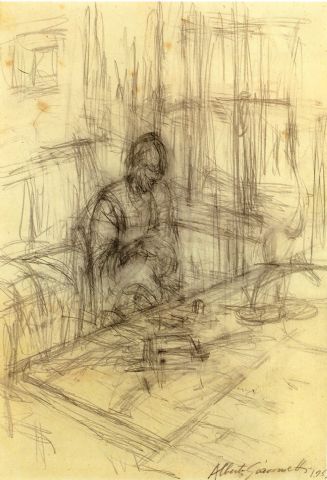
When you begin gesture drawing, you will focus on the entire form or structure of your study and dismiss surface details.  This make take you away from your interest in objective drawing, but gesture is the most efficient way of extracting the unique arrangement of forms and essential character of your subject.

Examples of Gesture 

                                                                  Honoré Daumier

 Riot Scene (1871), pen and ink wash

                                                                   Henry Moore
                                                                  http://en.wikipedia.org/wiki/Henry_Moore
Sheep Study (1972), etching


The Artist's Hand V (1979), Lithograph on paper

Etching by Henry Moore of an elephant skull, produced in the 1960s and printed as an album in 1970.


Eugene Delacroix
Lion Devouring a Hare (1851), red chalk

Lion Attacking a Boar (1851), red chalk

Alberto Giacometti
 Artist's Mother (1951), graphite
 Untitled (1956), engraving
 Annette Sewing (1954), graphite

Rico Lebrun


Claus Oldenberg

Pat Reading in Bed, Lenox (1959), crayon

Bicycle on Ground (1959), crayon

Claus Oldenburg video: 

Claes Oldenburg discusses the character of smoked cigarettes, through drawing and sculpture. Oldenburg displays excellent use of gesture drawing with vine charcoal.